George Zammit
Man on FireGeorge Zammit is a Maltese police inspector and commander of Malta’s counterterrorism squad. He first enters the story through his interest in Creasy’s weapons expertise, recognizing in the worn-down former mercenary a potential instructor; later, he uses his position to help Creasy and Nadia Schembri meet again. His appearances are brief, but they connect the disciplined work of policing with the novel’s movement from violence toward a fragile personal reunion.
Identity and Position
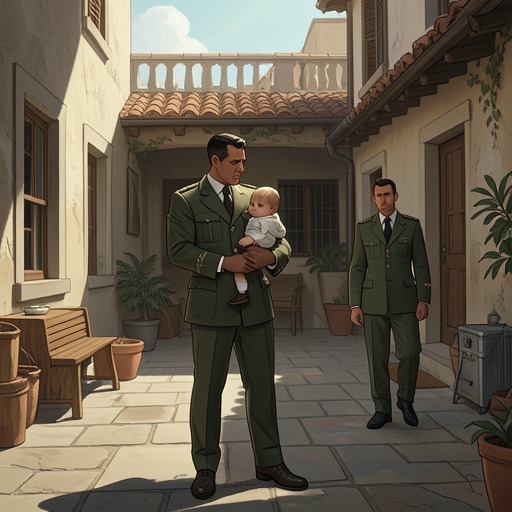
George is Paul Schembri’s nephew. Paul identifies him as an inspector of police who commands Malta’s antiterrorism squad, a recently formed unit whose members are enthusiastic but still inexperienced. George is also presented as large and friendly, qualities that accompany rather than diminish his professional attentiveness. He does not approach Creasy merely as a police curiosity: after watching him handle weapons, he sees a practical need the squad might fill by learning from him.
The squad’s existence is introduced amid discussion of a hijacking attempt in West Germany and the intervention of a specialist unit. Paul tells his family that Malta has a comparable force, and George’s command of it gives him a role at the intersection of local policing and the wider threat of political violence. The unit trains with weapons left by the departing British Army, including Sterling submachine guns and several kinds of handguns. Its fifteen members have energy and commitment, but their limited experience makes additional instruction potentially valuable.
Meeting Creasy and the Training Connection
After Creasy hears about the squad, he asks Paul whether George might let him train with its members. Paul makes a phone call, and the arrangement is made without difficulty. At St. Elmo, the old fort guarding the entrance to Grand Harbour, George watches Creasy work with the squad. They fire on a range in the fort’s depths and then exercise in the gym, practicing unarmed combat. Creasy is rusty and, by his own assessment, clumsy, but the afternoon gives him a chance to handle weapons again and begin rebuilding his physical readiness.
George observes the gap between Creasy’s present condition and his underlying experience. His verdict to Paul is emphatic: “The best I've seen,” he says, adding that Creasy handled the weapons as if he had carried them from his mother’s womb. George has taken training courses in England and Italy, making his assessment informed by comparison rather than casual admiration. The scene also shifts the emphasis from Creasy’s deterioration to the skill that remains beneath it.
George asks Paul to invite Creasy to dinner. He had avoided questioning him at their first meeting because it would have seemed rude, but now wants to learn more about him. The request has a practical purpose: the squad lacks instructors, and George thinks Creasy might help, though only very unofficially. His interest is therefore both professional and restrained. He recognizes expertise, but does not assume that Creasy’s history is his to demand.
The Squad’s First Full-Scale Exercise
George’s leadership becomes visible during a full-scale exercise. The action itself lasts five minutes, but the debriefing continues for an hour. He takes the squad through the different phases of the attack, criticizing some decisions and praising others, while Creasy stands beside him. The members are in high spirits: it is their first exercise on this scale, and its noise and activity have excited them. George’s extended review turns that excitement into a chance to examine how the operation unfolded, rather than treating the exercise as spectacle alone.
When George finishes, he asks Creasy for comments. The question acknowledges Creasy’s experience and places him alongside the commander, at least temporarily, as a second source of instruction. The scene develops the connection first suggested at the firing range: George is not simply impressed by Creasy’s ability but willing to make room for it within the squad’s training. It also gives Creasy a defined use for his knowledge at a time when he is working to recover his strength and coordination.
Police Inquiries and the Closing Reunion
Later, George’s name enters the Italian investigation into the violence surrounding the Balletto family. Mario Satta checks Creasy’s movements through official and personal channels, including a call to his Maltese counterpart. Satta knows George from a training course in Rome the previous year and likes him. George confirms Creasy’s arrival in Malta and reports that he departed by sea for Marseilles three weeks earlier. The information helps Satta reconstruct Creasy’s route, although it supplies no record of a return to Italy. George’s place in this inquiry is limited but concrete: his professional connection allows the Italian investigation to verify a movement that might otherwise remain uncertain.
His last appearance is quieter and more personal. In the dark harbor, George braces himself in a police launch as it enters calmer water and orders two seamen with boathooks onto the deck. The launch is held alongside the jetty. A Land Rover waits nearby, and George can make out two figures: a woman who appears bulky beneath her coat, and a large man whose feet touch down on their outer edges as he walks. When the man reaches her, she moves into his arms. George signals for the launch to pull away, then looks back at the embracing couple before turning his gaze toward Gozo’s dark hills.
The scene gives George no explanatory speech or claim over the reunion. His actions are enough: he oversees the arrival, allows the couple the space to meet, and departs without interrupting them. Across the novel, his attention moves from Creasy’s capacity to train a young police squad to the safe handling of a private meeting. In both settings, George acts through practical judgment and restraint. His final gesture places official authority in service of a personal ending, while the silent harbor leaves the couple’s embrace, rather than the policeman, at the center of the closing image.